The Science of Mental Fitness

It’s
a testament to the strength and versatility of the human brain that
anyone with at least half of one tends to assume that their senses give
them direct access to objective reality. The truth is less
straightforward and much more likely to induce existential crises: the
senses do not actually provide the brain with a multifaceted description
of the outside world. All that the brain has to work with are imperfect
incoming electrical impulses announcing that things are happening. It
is then the job of neurons to rapidly interpret these signals as well as
they can, and suggest how to react.
This neurological system has done a pretty good job of modelling the
world such that the ancestors of modern human beings avoided getting
eaten by sabre-toothed tigers before procreating, but the human brain
remains relatively easy to fool. Optical illusions, dreams,
hallucinations, altered states of consciousness, and the placebo effect
are just a handful of familiar cases where what the brain perceives does
not correspond to whatever is actually occurring. The formation of a
coherent model of the world often relies on imagined components. As it
turns out, this pseudo-reality in one’s imagination can be so convincing
that it can have unexpected effects on the physical body.
Nineteen Seventy Three
On
12 November 1971, in the presidential palace in the Republic of Chile,
President Salvador Allende and a British theorist named Stafford Beer
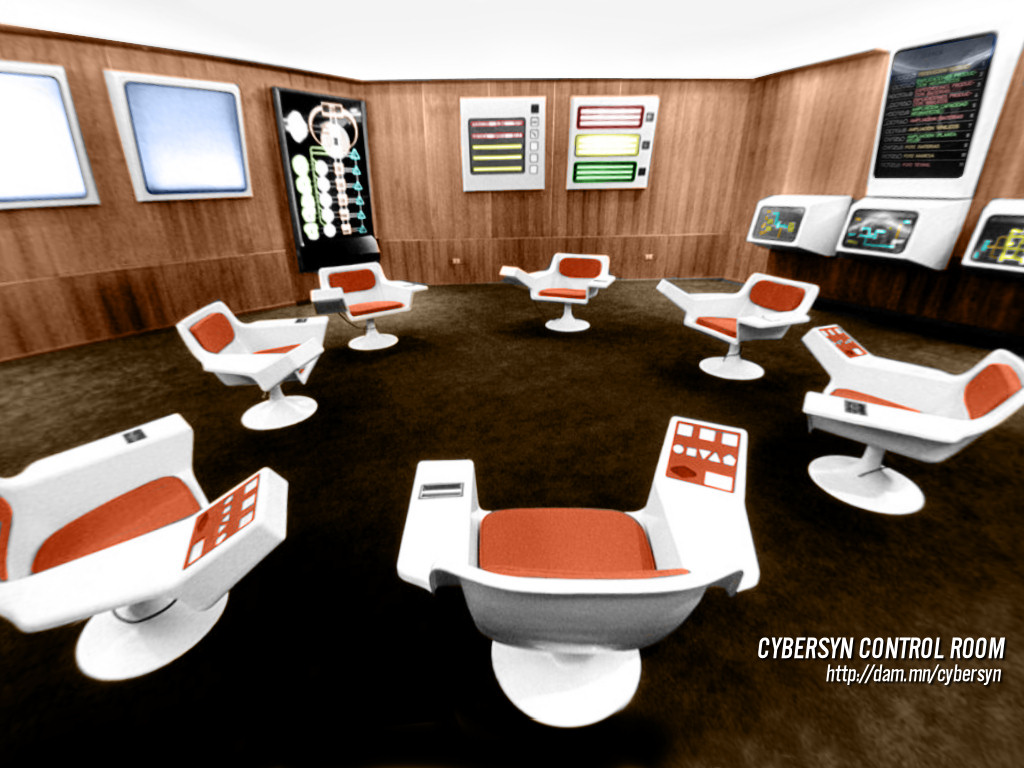
engaged in a highly improbable conversation. Beer was a world-renowned cybernetician and Allende was the newly elected leader of the impoverished republic.
Beer, a towering middle-aged man with a long beard, sat face to face
with the horn-rimmed, mustachioed, grandfatherly president and spoke at
great length in the solemn palace. A translator whispered the substance
of Beer's extraordinary proposition into Allende's ear. The brilliant
Brit was essentially suggesting that Chile's entire
economy--transportation, banking, manufacturing, mining, and more--could
all be wired to feed realtime data into a central computer mainframe
where specialized cybernetic software could help the country to manage
resources, to detect problems before they arise, and to experiment with
economic policies on a sophisticated simulator before applying them to
reality. With such a pioneering system, Beer suggested, the impoverished
Chile could become an exceedingly wealthy nation.
In the early 1970s the scale of Beer's proposed network was unprecedented. One of the largest computer networks of the day was a mere fifteen machines in the US, the military progenitor to the Internet known as ARPANET. Beer was suggesting a network with hundreds or thousands of endpoints. Moreover, the computational complexity of his concept eclipsed even that of the Apollo moon missions, which were still ongoing at that time. After a few hours of conversation President Allende responded to the audacious proposition: Chile must indeed become the world's first cybernetic government, for the good of the people. Work was to start straight away.
In the early 1970s the scale of Beer's proposed network was unprecedented. One of the largest computer networks of the day was a mere fifteen machines in the US, the military progenitor to the Internet known as ARPANET. Beer was suggesting a network with hundreds or thousands of endpoints. Moreover, the computational complexity of his concept eclipsed even that of the Apollo moon missions, which were still ongoing at that time. After a few hours of conversation President Allende responded to the audacious proposition: Chile must indeed become the world's first cybernetic government, for the good of the people. Work was to start straight away.
Stafford Beer practically ran across the street to share the news
with his awaiting technical team, and much celebratory drinking occurred
that evening. But the ambitious cybernetic network would never become
fully operational if the CIA had anything to say about it.
Pushed to the Limit
On
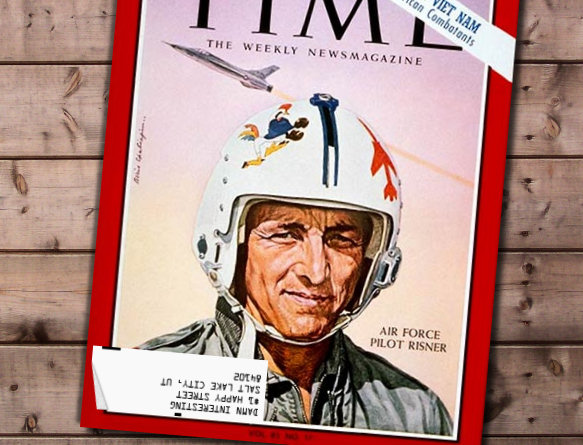
the morning of 15 September 1952, Captain James Robinson Risner sat in
the cockpit of an F-86A Sabre and scrutinized the clear azure skies. He
was leader of a flight of four Sabres tasked to escort F-84 Thunderjets
to bomb the kimchi out of a North Korean chemical factory on the Yuan
River. His squinty perseverance paid off when he spotted a flight of
enemy jet fighters-- MiG-15s--making a run for his Thunderjets. CPTN
Risner's opening salvo hit one MiG so hard it took the canopy off and
sent the other 3 MiGs running, but Risner didn't let it end there. The
injured enemy took it low, flying hard and dirty along a dry riverbed to
escape. Risner and his wingman gave chase, eating the dust and rocks
kicked up by the MiG's wash. Risner told "Aces in Combat":
The MiG darted, desperate to make a landing. Risner waited for his moment and hammered him with the last of his 50 CAL rounds. The MiG slammed into the tarmac and burst into flame. As they turned to hurry out of China and back into compliance with official US policy, the wingman, 1st Lieutenant Joe Logan, took a flak shell to the underside of his plane. The Sabre held together and stayed airborne, but her fuel tank was gutted, and her hydraulic fluid was bleeding out.
Bailing the crippled craft guaranteed Logan's capture, but there was no hope of making it 60 miles over anti-aircraft gun infested territory to the nearest rescue detachment. Risner couldn't desert his friend, so instead he did the only possible thing: he attempted the craziest and most daring rescue maneuver in aviation history.
"He was not in very good shape, but he was a great pilot - and he was fighting like a cornered rat!The wily chase took the trio into Chinese airspace. Low altitude and high speed conspired to keep the US pilots from seeing an airfield until they were right on top of it. The MiG pilot must have radioed ahead, however, because the field's anti-aircraft guns were manned and firing.
He chopped the throttle and threw his speed brakes out. I coasted up, afraid that I'd overshoot him. I did a roll over the top of him, and when I came down on the other side, I was right on his wing tip. We were both at Idle with our speed brakes out, just coasting.
He looked over at me, raised his hand, and shook his fist. I thought 'This is like a movie. This can't be happening!' He had on a leather helmet and I could see the stitching in it."
The MiG darted, desperate to make a landing. Risner waited for his moment and hammered him with the last of his 50 CAL rounds. The MiG slammed into the tarmac and burst into flame. As they turned to hurry out of China and back into compliance with official US policy, the wingman, 1st Lieutenant Joe Logan, took a flak shell to the underside of his plane. The Sabre held together and stayed airborne, but her fuel tank was gutted, and her hydraulic fluid was bleeding out.
Bailing the crippled craft guaranteed Logan's capture, but there was no hope of making it 60 miles over anti-aircraft gun infested territory to the nearest rescue detachment. Risner couldn't desert his friend, so instead he did the only possible thing: he attempted the craziest and most daring rescue maneuver in aviation history.
Night Takes Rook
Engineers
need to have faith in their designs, but not many would necessarily be
confident enough to put their lives at risk just to prove it. It takes a
great deal of faith to design a lighthouse for the most dangerous reef
in the English Channel, especially when no-one has ever built a
lighthouse on the open sea before. It takes rather more to actually
build it. And one approaches the shores of hubris when one decides to
visit said lighthouse with a massive gale on the way. But when Henry
Winstanley, an 18th-century English eccentric, designed and constructed
the world’s first open-sea lighthouse on a small and extraordinarily
treacherous group of rocks fourteen miles out from Plymouth, he was so
confident in his building that he blithely assured all doubters he would
be willing to weather the strongest storm within its confines – a boast
he had the chance to live up to when he found himself in his lighthouse
as the most violent tempest in England’s history approached its shores.
The Enlightenment Guide To Winning The Lottery
François-Marie
Arouet knew how to get into trouble. After a very public scuffle with a
nobleman nearly ended in a duel, the young playwright was exiled from
Paris, the city where his plays were only just coming into fashion. He
lived in dreary England for two whole years before slinking back to
France, where he lived in the house of a pharmacist. There he
experimented with various potions and poultices, but nothing would cure
the vague sense of impotence and dread that dogged him.
Finally in 1729 the gates of Paris were opened to Arouet again, but
he was still ill-at-ease. At a dinner party held by the chemist Charles
du Fay, Arouet, better known by his pen-name Voltaire, found the cure he
had been looking for. He met a brilliant mathematician called Charles
Marie De La Condamine, who promised a panacea better than any Voltaire
had found at his pharmacist.
It wasn’t medicine--it was money. Condamine had a plan that would make both him and Voltaire more money than he could ever scratch together by writing plays or poems, enough money to allow Voltaire to never have to worry about money again. He would be free to live how he wanted and write what he wanted. The plan was simple. Condamine planned to outsmart luck herself. He was going to arrange to win the lottery.
It wasn’t medicine--it was money. Condamine had a plan that would make both him and Voltaire more money than he could ever scratch together by writing plays or poems, enough money to allow Voltaire to never have to worry about money again. He would be free to live how he wanted and write what he wanted. The plan was simple. Condamine planned to outsmart luck herself. He was going to arrange to win the lottery.
Better Call Sol
The sun as seen through the SOHO Extreme ultraviolet Imaging Telescope (EIT)
We now know that such solar minima correlate quite closely with colder-than-normal temperatures on Earth, but science has yet to ascertain exactly why. Solar maximums, on the other hand, have historically had little noteworthy impact on the Earth apart from extra-splendid auroral displays. But thanks to our modern, electrified, interconnected society these previously innocuous events could cause catastrophic economic and social damage in the coming decades.
The Tyrant of Clipperton Island
Clipperton Island, with the freshwater lagoon visible in the center.
Meddle, Metal, and Mettle
In
1881, silk top hats and bow ties were the height of gentlemanly
fashion, monocles were the preferred means of corrective vision, and the
suggested greeting on newfangled telephone contraptions was a cheerful
"ahoy-hoy". One June Saturday of that year, as the sweaty, swampy summer
was just beginning to settle over Washington DC, a gentleman strolled
into the US capital’s district jail on the banks of the Anacostia River.
The visitor was well-dressed, about 40 years of age, slight of frame,
and sunken of cheek. A weedy patch of gray-tinged whiskers sprouted from
his chin, and his face was punctuated by a pair of dark, wide-set eyes
which were predisposed to shiftiness. He was an attorney named Charles J
Guiteau. He approached the attending guard at the Bastille jail and
requested a tour of the facilities.
Deputy Warden Russ eyeballed the man, as deputy wardens do, and
explained that visitors were only allowed to tour on particular days.
Undeterred, Mr Guiteau surveyed the fraction of the structure that he
could see from the office, and remarked that the facility was, "a very
excellent jail." The steadfast deputy warden urged the would-be
sightseer to return at a more appropriate time. Mr Guiteau decided that
he would do exactly that, and departed.
 Although Charles Guiteau was a licensed lawyer, his visit to the
Bastille was not on behalf of a soon-to-be-incarcerated client. As he
would later explain, he had visited the prison to "see what kind of
quarters I would have to occupy." Perhaps most importantly, he wanted to
ensure that the structure would be able to withstand the angry mob that
would soon pursue him. Such were the details that a gentleman must
attend to when he plans to assassinate the presiden
Although Charles Guiteau was a licensed lawyer, his visit to the
Bastille was not on behalf of a soon-to-be-incarcerated client. As he
would later explain, he had visited the prison to "see what kind of
quarters I would have to occupy." Perhaps most importantly, he wanted to
ensure that the structure would be able to withstand the angry mob that
would soon pursue him. Such were the details that a gentleman must
attend to when he plans to assassinate the presiden